One Night at the Hotel Bothwell
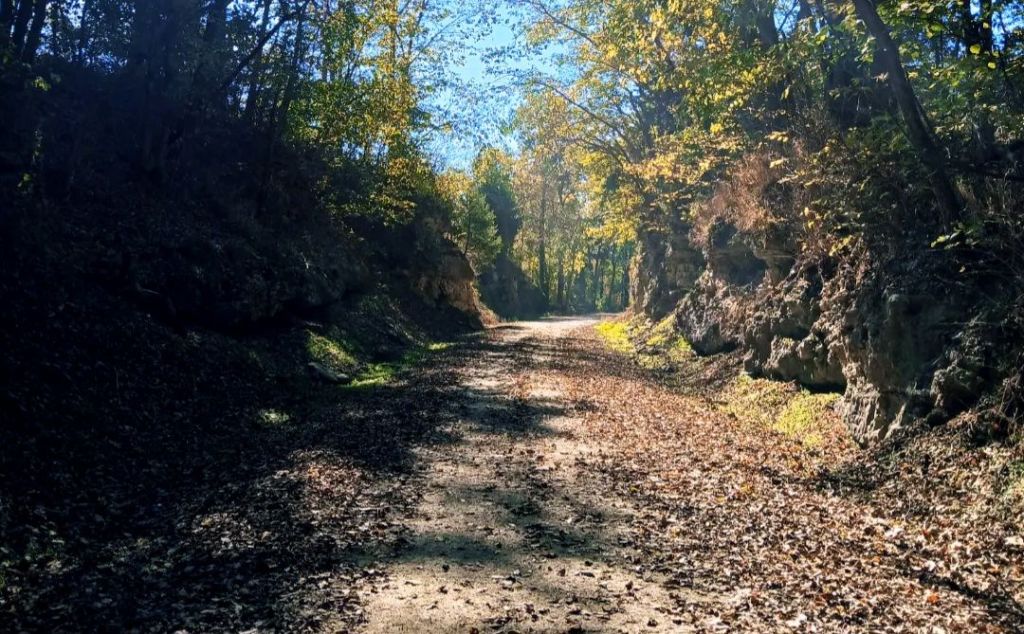
I wager that a sum of what makes me unpopular is a measure of success.
_____
I have a question for you, dear reader. If you could choose only what you could do, have, or be at the beginning of your life, which path would you take? Please accept my signature blank space to consider before continuing.

Long rides planned and long rides planned with a destination never invited the same form of woman out of the door in the morning. She was not questioning how her legs felt or negotiating with pace or passing traffic as she left for an 85-mile trip westward. She was a quiet object in the roadway allowing the music to set the mood rather than to manufacture hype. Flow state met her at the stop sign down the street.
She had packed both of her costumes into an oversized saddle bag; kit, a black mini dress and heels, and a rigid notebook were an advertisement for Impractical Bikepacking for Dummies. Makeup and chamois cream contended for space in a snack bag at the front of the bike.
Within the first five miles, life’s current casualties were left in post-harvest fields, and in their place a single roadside chicory plant consumed her attention even after she passed it. She remembered the first time Papa overpronounced its name, CHICK-KER-ee, to her as it grew along the edges of his gravel driveway. It does the same in Missouri every summer but, like another season of lost racing opportunity, she thought it was gone for the year.
But that single, proud sprig was like a gesture of grace for opportunities, stories, and people lost.
Here, Genna. Do, have, be what you want this day.
She had left for the long gravel trail and a historic hotel for much the same reason as Thoreau went to Walden Pond, only rather than insisting on living deliberately, because that would still be assigning a subject to an essay before she had experienced it, she left to let it show itself across the hours.
Rolling up to the first opportunity for trailside coffee, she argued. The instinct and satisfaction of being efficient with time was in deliberation with it being rendered unnecessary this time. And while the absurdity of that being a debate could be clinically diagnosed as overthinking, overthinking it further reveals the real condition of how she’d trained herself to function and then me slapping her upside the head, saying
Just stop for the coffee, damn.
So she sat with a crooked helmet and a pinky out and listened to the mother a table over speak to her very young child like a capable, insightful adult.
The gas station stop had her standing in line as a man in motorcycle leathers walked up. He asked her how far she was riding, and she answered. He gave the expected shock response and offered gratitude for his motor.
“That’s the smarter way,” she said, as she often does, and let the chat end there.
Genna. Hello. You said you wanted to meet strangers this weekend.
“Where are you headed?” She then asked.
And there it was. The bridge between being polite and being present. They exchanged a couple more sentences and then she headed back outside. They gestured goodbye to each other as she rolled out of the parking lot.
She entered a trance from there to Sedalia. She didn’t remember much that the narrator said within those 35 miles. This trip is the first time in twelve years of riding, and less than two of regular writing, that she understood that there is a substantial amount of thought that surfaces while in motion and dives back down to be forgotten about before she ever sits down with that notebook. Once that was realized, she repeated a singular line that came up on the way home so it didn’t vanish like many others.
I am pretty sure that the potential impact you can have anywhere is directly proportionate to the number of uncomfortable truths you can acknowledge.
Groundbreaking in motion, vetoed with the notebook in hand for being too vague.
_____
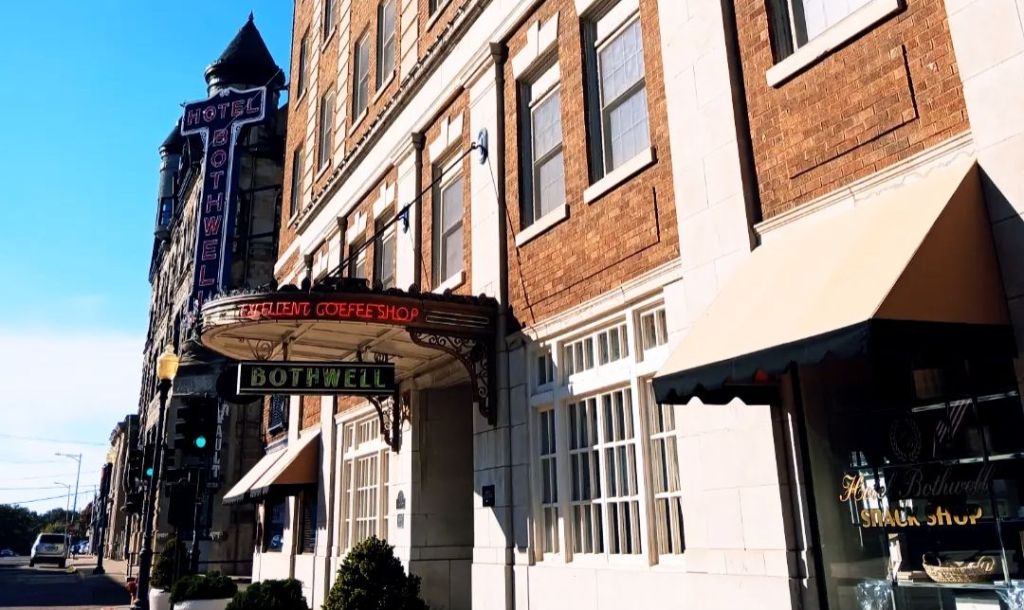
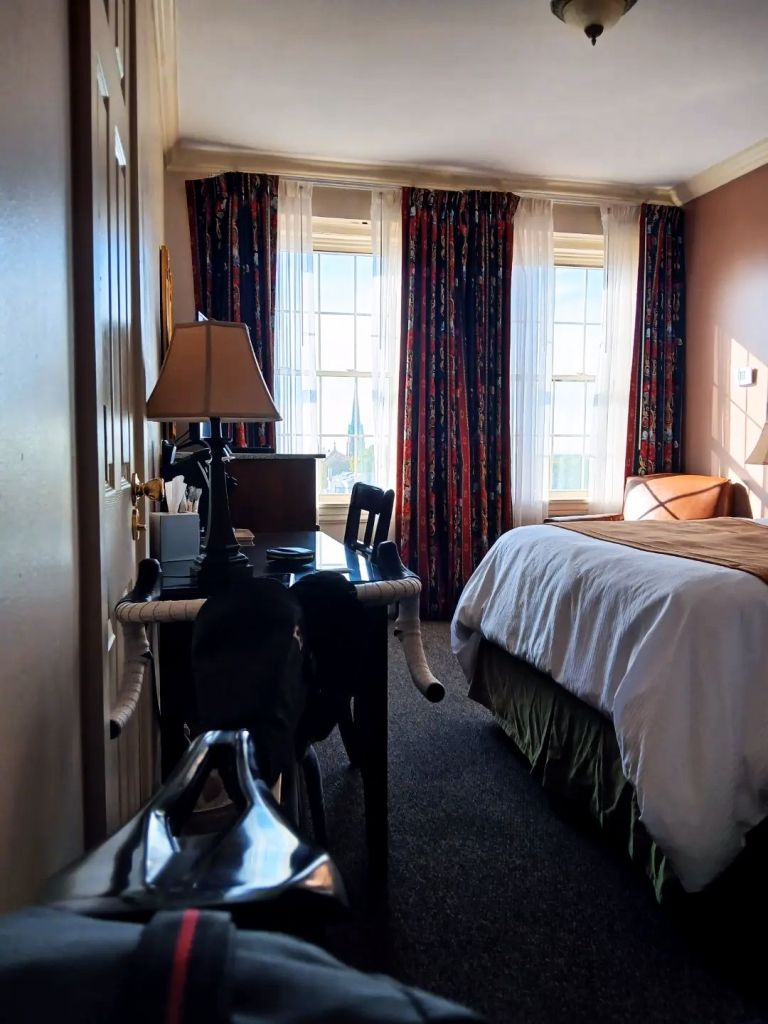
She reached the hotel and, in her tourist voice, took the staff up on their offer for a ride up to her floor on the original elevator, bike and all. Feeling the cool draft through the gates as the attendant lifted them up the floors was a novelty, as was the narrow, creaking door to room 611. The building was updated just enough to not feel haunted, with enough echoes of its birth in the 1920’s to keep someone immersed in that fact.
She metamorphosized from machine into solo, pensive young woman as she washed up and put on that dress, sharp eyeliner, and returned to the lobby with her dandelion-colored notebook with the gold-trimmed pages. She found the moody corner she had hoped for in a separate room between the bar and the restaurant, seated next to a wall of a wine collection she didn’t dare ask about.
Over the course of that evening, she had her go-to Moscow mule, two specialty cocktails, and a plate of pasta with steak on top that she was thoroughly impressed by but equally skeptical was placebo; a mind trick generated from the awareness that she had never ordered a $33 entre for herself while seated alone before.
Dear reader if you’ve ever felt it would be too awkward to sit alone in a nice restaurant, the look she received from one of the servers in this space, and the richness of thought that arrived with the martini glass, suggests it communicates something quite different.
And I became aware that to sit there with someone else would have been less harrowing, but with just me was more loyal. I thought about what it might feel like to stand on the table.
My session ended recollecting the final scene in Dead Poets Society, forever my favorite film.
If you aren’t familiar, a group of students at a private boarding school have been inadvertently broken of their usual instruction by new English teacher and alumni Mr. John Keating. They become compelled to step outside the lives determined for them by an institution, their parents, and social pressures as they acquire tastes for themselves in a cave reading the texts of the old poets, the free thinkers. The quiet rebellion follows them back to the dormitory.
Inspired to pursue one of his own dreams for his life, one of the students, Neil Perry, takes a role in a school theatre production against his father’s approval. After his father discovers Neil’s disobedience, he initiates Neil’s withdrawal from the school to enroll him in a military academy instead.
Neil proceeds to take his own life.
And as an authority tends to when it cannot confront it’s own needs for control over a people, it blames Mr. Keating for installing ideas it perceives as detrimental into the minds of impressionable students and fires him. As he packs his belongings under force by the headmaster, the student most conflicted about defying expectations for the entire film stands on his desk and says, “Oh Captain, My Captain,” as introduced to them at the beginning through Walt Witman’s poem. Each student, one by one, follows his lead.
“Oh Captain, My Captain.”
I remember nothing more vividly from my school years.
Not even my parents’ rage in the living room, nor their blaming me for conflict, is as clear now.

But before I made the decision to head back to my room, I overheard a server saying that a large table in the adjacent room were regulars. They were all within the age bracket that tends to either issue unsolicited advice to someone my age or recognize the “life experience of a 100-year-old woman” I sometimes exude.
Do it, Genna.
So, I walked to the bar and asked the server if she would ask the table if they’d be up for a writer coming to join them briefly to chat. Shortly thereafter, I took a seat at the single empty chair left by a man who had gone early. I introduced myself and then asked them,
“If you would, go around the table and, if you can think of one, tell me a brief story from your life that you’re fond of.”
The group looked to a man named Byron to speak first, and he told me how he’d moved from California to Sedalia for a Victorian house that many at the table then shared their appreciation of. He later told me about the renowned ragtime festival that is hosted in the town every year.
The group soon fell back into chatter about their ties to the town, how it had changed during their time. They told me about its railroad roots and seemed to briefly forget that the rail line was now the trail I rode in on. None of them returned to my original prompt, which was excellent.
They weren’t trying to appease the writer. They were just letting me be a part of their world at the end of dinner.
Seated next to me, a man named Bill was amongst the two that laughed the most at the style of humor I developed partially from Papa’s influence.
“Hey, I’m just an idiot.”
“You’re not an idiot,” Arlene said.
As I was listening to Becky speak, Bill commented to Clell that, “She’s not even writing anything down.”
My eyes and ears still on Becky, I lean toward him pointing to my temple as I say, “I record up here.”
I am aware of where the attention of this entire table is right now.
Because what they didn’t know was that I didn’t need content for a story. I was there because what often happens when I break my own social habits breaks another piece of the wall my parents built in front of me.
Arlene was the one who seemed particularly interested in who I was and I told her how I had grown up in a house that was fairly agoraphobic. My mom had almost no contacts outside of family and lashed out at a greeter at Walmart once. My dad was a different person at work than he was at home. I was taught through their behavior that they viewed the outside as grossly untrustworthy.
I learned in adulthood that it’s simply complying with its own programming.
And somehow, I became the interceptor of Genna’s.
I had to touch her gently on the shoulder briefly as Bill mentioned the writing again and asked, “Is this lucrative work for you?”
I have been confronted lately with two truths that have haunted me for life:
- My conviction to live in accordance with my own standards, at all costs, does in fact put me at worse odds in society.
- There is no alternative. I cannot negotiate with her. I’m just a narrator.
When I inevitably return to that dark space where I have to face that my life remains precarious because I refuse to put on a false smile for those with something over me, spend every available hour chasing income, or sacrifice what doesn’t provide meaningful “progress,” toward standing completely on my own, I get up and stand on the proverbial desk instead.
I swing a leg over a bike.
I’m not sure my racing objectives ever stood a chance when the point of that arena is to prove something to someone, even if its you.
I had to let her figure that out on her own, though.
And it was a beautiful night at the Hotel Bothwell.
If only life was so simple, I’d choose to be, then maybe the rest would fall in line.

