If I’m honest, I don’t really write to make sense of my life or to process emotions. That has generally already happened before I get here, because that feels like the most responsible way to handle sensitive material.
It seems that I write because I was born into a household where reality was already being translated by adults that could not allow it to be freely observable, and I needed witnesses. I was rendered without power, as any child inherently is, and my only options left were to succumb to what insisted it knew better than me, or get distant and watch.
I watched so intently and became highly adept at describing what I saw.
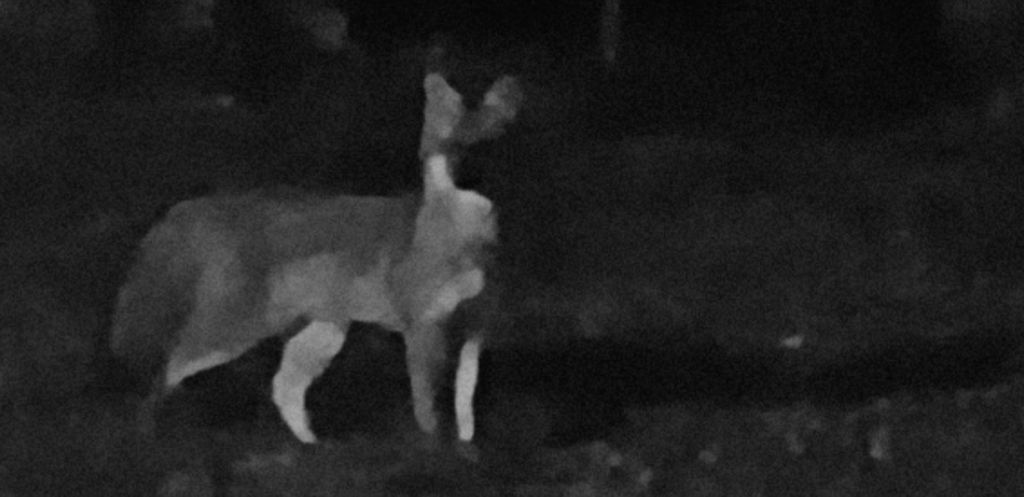
Twice now, a gray fox has appeared in the yard. The first time, it paced at a distance while curious about a cat fight that had broken out. It didn’t pay much mind to me until the tussle resolved, and then we both sat still and watched each other for several minutes.
Weeks passed and it showed up again, this time in full daylight. I went still again but spoke gently to it so it knew I was there. It again stopped and watched me.
_____
Put me in a room with another reserved person,
and you have an instant stalemate.
Start indicating whatsoever that you find me interesting,
and I can’t take a compliment.
Tell me where I belong and I will rapidly make that judgement for myself.
Show me where I am welcome, and leave me to make the choice, and I will spend days unsettled by it because it’s novel to me. I have an entire archive of being pointed at as the problem,
and a few water-stained pages of “I see you. Feel free to hang around.”
They get entered as evidence before invitation.
And most of those were written by me because I had to stay distant, and watch.
You cannot do both, Genna.
_____
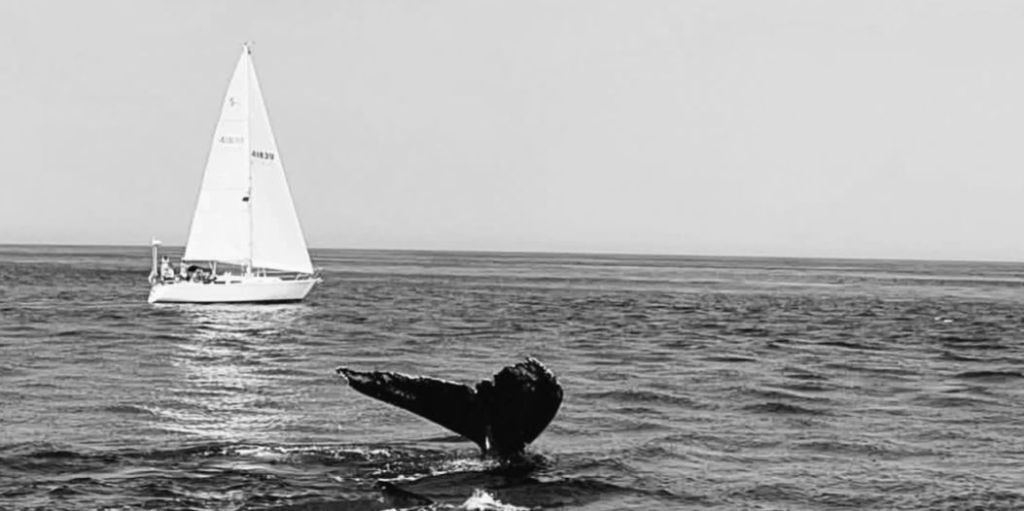
A few summers ago, I was on the Maryland coast about to board a whale-watching boat. The chatter around me was mostly “I hope they’re active,” and “I have Dramamine.”
I regularly prioritize experience above everything else. Because if I only get this one life, I’m not going to sacrifice feeling it for how my decisions look to the outside.
But I equally struggle to ever fully live in a moment of time. It’s always managed by remain distant and watch.
But miles into the Atlantic, I was woken up by the rocking of a double-level vessel pushing waves in search of humpbacks. Someone was dry heaving by the railing and I was scurrying up and down the stairs breathing in the salt like I had only then discovered oxygen.
We found whales. Everyone had their phones out. I was seven again.
The boat cut its engine. We kept a distance, and we watched.
_____
Recently I met an acquaintance for lunch after work. I was equally excited as anxious because whether I am met by or a rub to someone else is always a dice roll, and I’m apt to gauge it quickly.
What followed was three hours of discussing shared interests as an appetizer, and an indulgent main course of comparing how each of our minds seemed to work with rigor that rivals this blog. We weighed the benefit of playing the social game versus my refusal of it. Their “I don’t want other people to know that I read them,” across from my “I do.”
That was the first time I had ever spoken to someone that could translate their self-observation into my language and felt inclined.
I was back on the boat.
_____
I don’t watch much TV; I’m busy paying attention to other things. So if I catch a reference, you should probably purchase a lottery ticket immediately.
But I love Ted Lasso so much I’ve watched it twice. I was watching it with my boyfriend, Alex, on the second run, and we reached a scene where one of the mainline characters, Nathan, is in his childhood bedroom after walking away from a major career. The show traces parallel emotional moments of other characters to the sound of Nathan playing his violin.
Suddenly, Nathan’s dad, whom has been portrayed as detached and disapproving, appears in the doorway. Nathan is startled, and begins to apologize for the noise.
You can watch the two-and-a-half minute scene here. My summary will not suffice.
“I didn’t know how to parent a genius,” his dad admits.
“A what?” Nathan replies, frozen.
“A genius. You’re brilliant. You’ve always seen things other people couldn’t and that’s a blessing. Yet I know it must also be a curse too.”
Alex looks at me and says something like, “What’s that like?”
“What?” I reply, frozen.
He saw the hit. He mentioned it again the next day.
_____
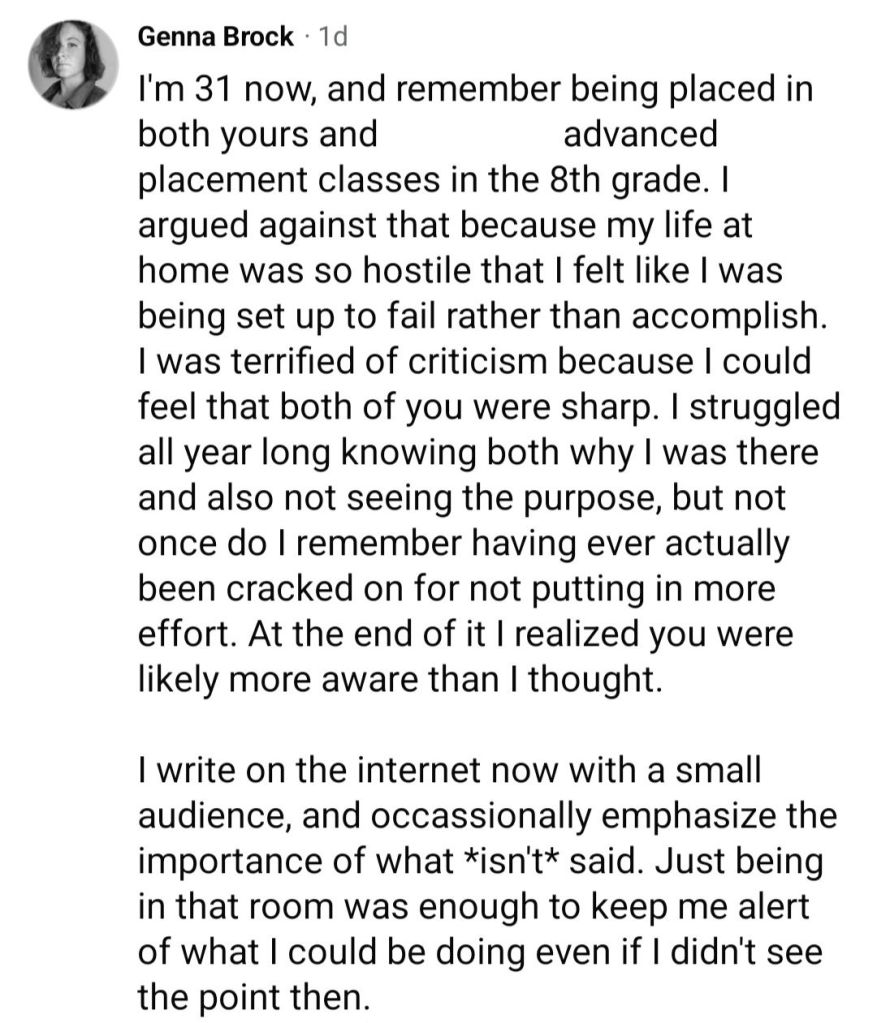
I remember 7th grade being the year where I began to sink. Everything at home was deteriorating. I was pushing back more.
But I had one teacher that year whom I trusted completely and bonded with well enough that I carried that energy into a test score that landed me in advanced English the next year.
I couldn’t half-ass my way through anymore, and I knew it.
I did not value the reflection of potential because I dreaded going home every day and had no concept that a future existed for me.
I could feel that my parents would discard me as soon as legally permitted (and they did).
I couldn’t take my eyes off of the situation in my house long enough to apply myself to anything else.
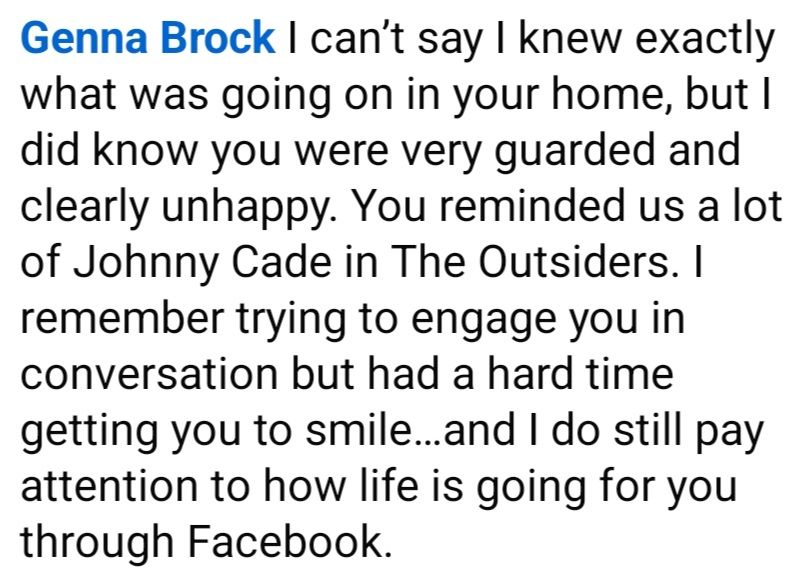
I saw a post from one of those teachers this week about what keeps her driven in the profession, and to summarize, it was seeing the impact in, and being seen within, her efforts.
I commented.
_____
_____
I am so studied of projections and ridicule that I have an armory for it.
“You’re too untrusting,” has come predictably from those who later showed me I could not trust them.
Those more like me seem to speak differently, or simply less, than I do.
The fox is in the yard again.
How long have you been here?
Am I the last to arrive again?
 I will the machine.