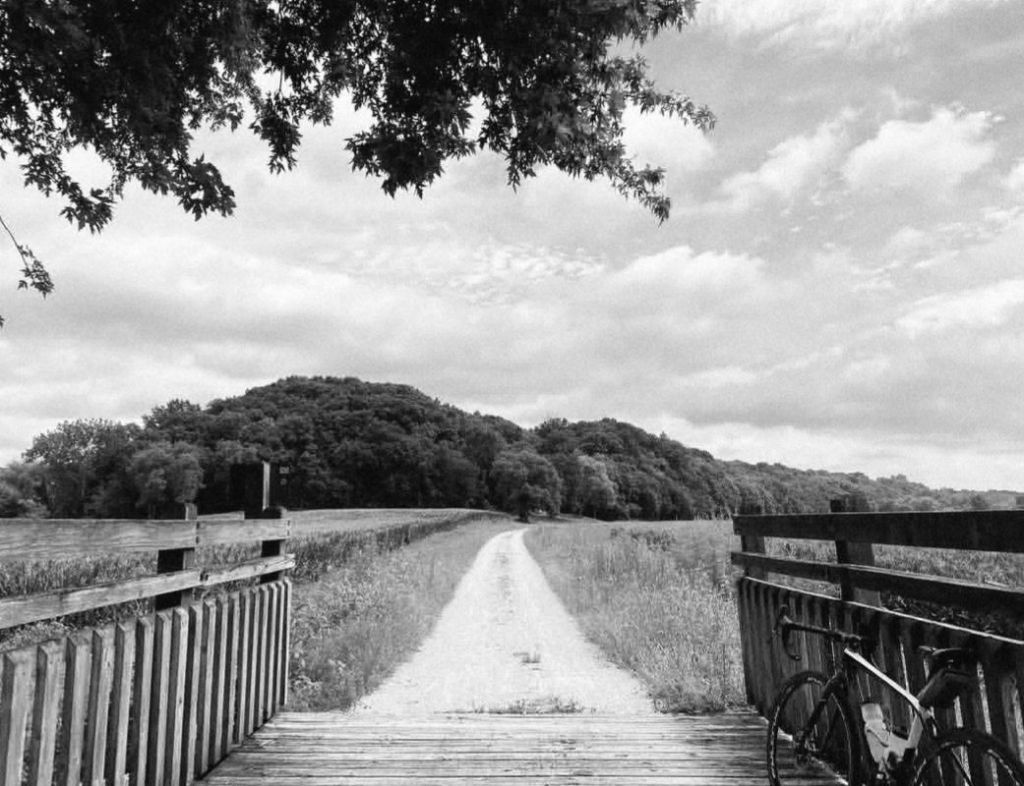
This month, both the men’s and the women’s fastest-known-time records for the 239-mile Katy Trail were broken. The route is run from the western terminus in Clinton, MO to the east in Machens. The trail is predominantly flat with one section of subtle grades that stretches roughly 30 miles, and highly exposed for long and frequent periods.
The latter was accomplished on October 21st, a Tuesday, with a steady wind out of the west-southwest at 18-25 miles-per-hour, with gusts higher, according to the National Weather Service.
I planned my own ride that day with consideration of that windspeed, choosing to ride the local section of the trail southeast and attempting to hide from the turbulence in the hills on the way back home. That was hardly effective, and I nearly put a foot down on a paved climb as a gust brought me close to a stop.
I titled that ride on Strava “Why?” as in why the f*** am I out in this? It was arguably a perfect day to be on a bike otherwise.
Dear reader,
It was my record time that was bested that day. Before I continue, I want to acknowledge that I am in a strange position as an athlete, writer, analyst, and deeply critical thinker compelled to question a result, fully aware of my own bias. I want to make it known that I am not contesting that the result be disqualified, or commenting on the character or personal motive of the athlete at the center.
Records exist to be broken. The pursuit of them is what gives them their value. They are a numeric representation of having discipline, a drive toward exploring human capacity in physical and psychological arenas, and cojones of record proportions of their own.
With that being said, I raise you this:
1. How much did an environmental advantage possibly augment a result?
FKT’s are determined by elapsed time, rather than moving speed. I have had to defend that fact on my first completion of this ride in 2022, and I am not going to nitpick that on someone else’s data now. This comparison is presented for my inquiry of wind effect.
My time: 14:40 moving, 16:27 elapsed
New record: 14:00 moving, 14:33 elapsed
Only 40 minutes of that time difference is moving speed; the rest is stopped time. Whether or not a major tailwind over 239 miles influences stopped time is extremely nuanced and indeterminate, so I’m not going to touch that. However, I did ask AI (I do words, not math) to calculate potential moving speed advantage of a 20mph tailwind versus the 5mph wind from the southwest that I had during my effort:
On flat terrain at endurance pace, a stronger tailwind lowers effective airspeed, so the same effort yields a bit more ground speed. A modest ground-speed bump of +0.6 to +1.2 mph over ~239 mi translates roughly to:
- +0.6 mph → ~25–30 min saved
- +0.8 mph → ~35–40 min saved
- +1.0 mph → ~45–50 min saved
- +1.2 mph → ~55–60 min saved
I then asked it how common this wind speed and direction was for central Missouri:
Very high sustained tailwinds (e.g., 18–20+ mph aligned with the trail) show up as rare “strongest” wind-events rather than typical conditions. For example: one source records a “strongest 16 April, 2024 – 26.4 mph SSW” for Columbia.
2. How does opportunistic timing possibly harm opportunity in endurance records?
239-miles is not a neighborhood Strava segment. Riders attempting to ride the Katy (or any other solo FKT path) in one push are typically planning weeks or months in advance and crossing their fingers for weather that is manageable. Capitalizing on a rare wind event from the perfect direction to post the fastest time creates a standard that limits accessibility for anyone to challenge it that isn’t extremely lucky, can’t logistically pull together an attempt on short notice, or ‘pro enough’ to beat it in normal conditions. As an outside example, a tailwind advantage is so widely recognized that the Boston Marathon winners’ finish times are ineligible for world record consideration because of the high probability of tailwind skew.
Nothing about this choice is against the very few rules of the FKT, and all that technically counts is the data recorded and the label of ‘supported’ or ‘unsupported’. And, giving grace to the small chance a challenger lucks out with conditions that favorable, there is, in my opinion, a responsibility to be transparent about that variable.
3. If how we approach individual athletic feats of this scale is boiled down to just the data that qualifies, does the rest of the story matter?
I can’t answer that for you, dear reader. For me, the whole story is the definition of an effort, even if I’m not on the top step. All of my previous work is written from what ultra-endurance endeavors showed me about myself rather than what they communicated to observers.
I don’t want to be the frontrunner from anything other than what I am capable of under my own power.
And since the sword imagery I use in my writing is not there because I’m simply a keyboard warrior, I am going to try to run the new posted time down next season in more neutral conditions.
And if you’re still compelled to ask me, “Why?”
then I have a counter-question for you.
4. Why would anyone need the wind?
 I will the machine.