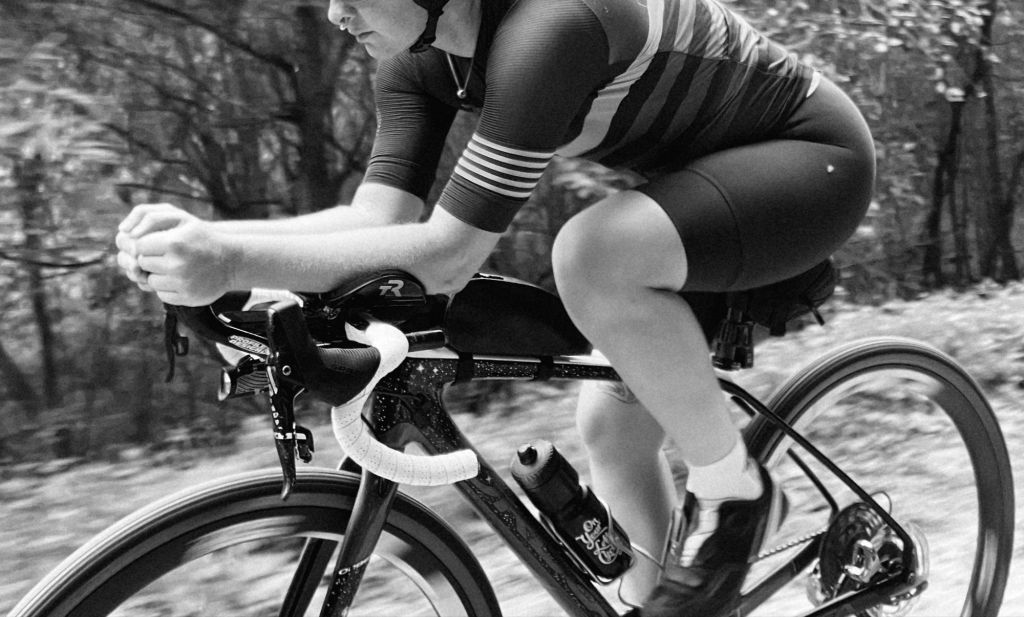
I pressed through Nyx’s dominion with the moon floating centered with the break in the trees. The glitter of thousands of spider eyes caught by my headlight traced the edge of the trail for eighty miles or more. I found that deep rhythm I had been seeking, and it carried me further into the dark than Hypnos had allowed so comfortably before.
But I was hemorrhaging stars more severely than I had thought, my fuel still leaking through cracks faster than I could fill them. I reached the river as the moon set behind me, and every breath felt like another ghost of the westbound wind would enter. I tried to shake them out as I dragged myself to my next stop. Hypnos had grabbed both of my crew in Rocheport, but I resisted his sudden claim to me.
I left with Eos’s golden gate within sight. I pressed right up against it with a respect and composure I hadn’t before, but it still would not open.
This was the place. I should have been home free with the sun’s grace. But instead, I heard that burried voice again, and Thanatos said,
“You shall not pass.”
_____
I had to retire at mile 163 of 320 on the morning of October 5th. That closure to an epic mirrors the end of the race described in Depths Too Dark, where a series of overnight errors, a temperature drop, and sleeplessness led to what all signs point to as parasympathetic (dorsal-vagal) collapse at sunrise. What I’ve learned since that episode is that the central nervous system of a person who has experienced long-term trauma often has a narrowed window of tolerance for stress. I’ve lived in a chronic state of stress for most of my life, as evidenced by my storytelling and beginning to go grey at just 19-years-old. I’m so used to living in hyper-vigilance and heightened sensitivity that it’s simply my baseline. I never get to start a day or an ultra truly “safe.” So, although my conscious mind understood I was not in any real danger out there, all of the compounding “threats” and adrenaline in the overnight hours brought me too close to my ceiling.
And my body simply wouldn’t fight anymore. No amount of willpower or stubbornness was going to override it.
I kept all of that in mind as I began this trip, thinking the trail wouldn’t produce the same trigger points because I trusted it. I ate even more frequently than I usually would, rotated headlights to eliminate worry about battery life, saved caffeine only for when I really needed it. I kept my effort level low and slow in the headwind, let the wrong turns on the road sections roll off, and told the wildlife that it was their problem to move out of my way if I came too close instead of playing midnight Mario Kart (they did).
As I drew near the halfway stop, I grew cold, lethargic, could not get my heart rate above about 120bpm; I could only pedal for a minute or two at a time before having to coast and stand up off of my saddle. I couldn’t take deep breaths, but staved off the hyperventilation that occurred during the failed race in the spring. I was travelling at 11mph on a stretch I could normally hold 16mph under the same effort, and felt desperate for the support car that was only a few miles away. This set of symptoms can also mark “bonking,” or running out of glycogen stored in the muscles, but I was incredibly careful to eat and hydrate properly. I knew how to handle myself and press on through discomfort, but my body just wouldn’t let me.
What I didn’t know, though, was the reality around the body’s hormonal and metabolic shifts in the overnight itself. The pre-dawn hours are physiologically the most vulnerable, and where I chose to just take a longer break rather than try to get any sleep. Daylight wasn’t far away- I didn’t have to ride with tunnel vision or cold for much longer, so why get complacent here? After about an hour sitting in the truck, I got back out for the next leg. I spent another eight miles just begging myself to come back online. After about 30 miles total in an absolute pit, I sent a text to my crew to come get me, ironically at the closest trailhead to home.
Whereas dawn approach tends to lift or relieve most people of delirium, my body interpreted the “safety” of first light as a cue to shut down rather than to recover. It mimics how I used to shut off and isolate in the wake of disputes in my household as a kid, and therein lies the lesson. For a subconscious that never truly reaches a state of true calm, the body will eventually be forced to manufacture it.
And then I’ll still foolishly beat down on myself for just not being gritty enough.
_____
My initial conclusion was that the steady uphill, speed-drain of the Rock Island portion of the route took all my power away. Now that I can think a little more clearly and have had time to analyze the experience, the pattern doesn’t suit that explanation. Just as before, this premature ending was again, tragically, the fault of something on an autonomic layer.
Right now, it’s difficult for me to not to view this as a sort of psychological handicap. I have to consciously bring myself down from the frustration that I am wired in a way that places limitations on athletic pursuits that I am otherwise physically capable of.
The pre-recorded voices, that aren’t my own, tell me I continue to bite off more than I can chew. That I’m too broken. That I screwed up by showing up. I consistently live under this assumption that I’m looked down on for daring to try so publicly because for more than half of my life thus far, I was.
It’s only recently become obvious that this isn’t the norm, even though I always knew the behavior that caused it wasn’t right.
A pattern of thinking I’m also trying to bring back to ground level is that 163-miles isn’t short even if it’s substantially less than my target… Doing that and being recovered by Wednesday is no fluke.
_____
I went out there to have more conversations with myself. I got them. I came back with data on a weak spot I’ll have to learn to work with, rather than through, to prevent this kind of ending from transpiring in my future ultra pursuits.
I said in a Facebook post a few days ago, in my heartbreak, that I probably would not reattempt because I thought I’d been beaten fairly.
But I wasn’t. I was being protected. Again.
So I think I will try again, now understanding that force of will only works up until you become your own enemy and the daemon of nonviolent death forces you down into your seat.
When we meet again, I’ll shake his hand, and wait my turn.
 I will the machine.