One day, when I was in elementary school, Papa took me to the park. I was spinning the faces of the tick-tack-toe game on the playground by myself when another little girl came up to me and asked what I was doing.
“Does it matter to you?” I snapped.
She looked at me with complete paralysis for a long moment, and then ran away. Papa heard the whole thing. He marched across the mulch and lectured me about how incredibly unkind I was, and made me apologize to her on the spot.
I remembered how badly I wanted to be one of the popular girls I admired in school. I connected that with how unwelcome they made me feel, and so I tried on that behavior for myself that day.
That was the first and the final time I tried to become someone I was not.
That memory stands out more vividly than most from that time period. And although I can’t be sure, I believe Papa’s quick motion to step toward my hurtful response, and forcing me to correct it on the spot, played a major role in me learning to both self-analyze and adapt reflexively.
He taught me to watch for my impact on others before my parents had the opportunity to poison my self-awareness with permanent doubt.
To the point that I started to turn that reflective surface back at them. I would narrate all of the ways they caused my siblings and I harm, and hoped they would be invested in correcting it the way I was taught to when I misstepped.
But it was intolerable to them, and I was punished for then seeking the right thing.
How disorienting.
_____
If someone was to say to you that they could see right through you,
what is the first thought that comes up for you?
That it’s some woo-woo shit?
Does it make you want to back away?
Are you curious about what they may perceive?
Could you then explain why?
Because the children of people who could not look at themselves, because they would not survive the clear image if they did, are forced to adapt in one of two ways:
Look away, from both the behavior that hurts them, and themselves,
or look closer.
And oh, how has choosing the latter both saved me,
and devastated me.
_____
I had to step back from someone important to me, again.
I do this a lot, and it’s almost always once I see that someone isn’t moving in a way that parallels their words.
And people do this a lot.
“I want this,” -> I will choose not to act on that right now.
“You’re so smart,” -> I will respond negatively to you not taking my advice.
“I’m a good person,” -> I will communicate to others that you are not.
And the space between,
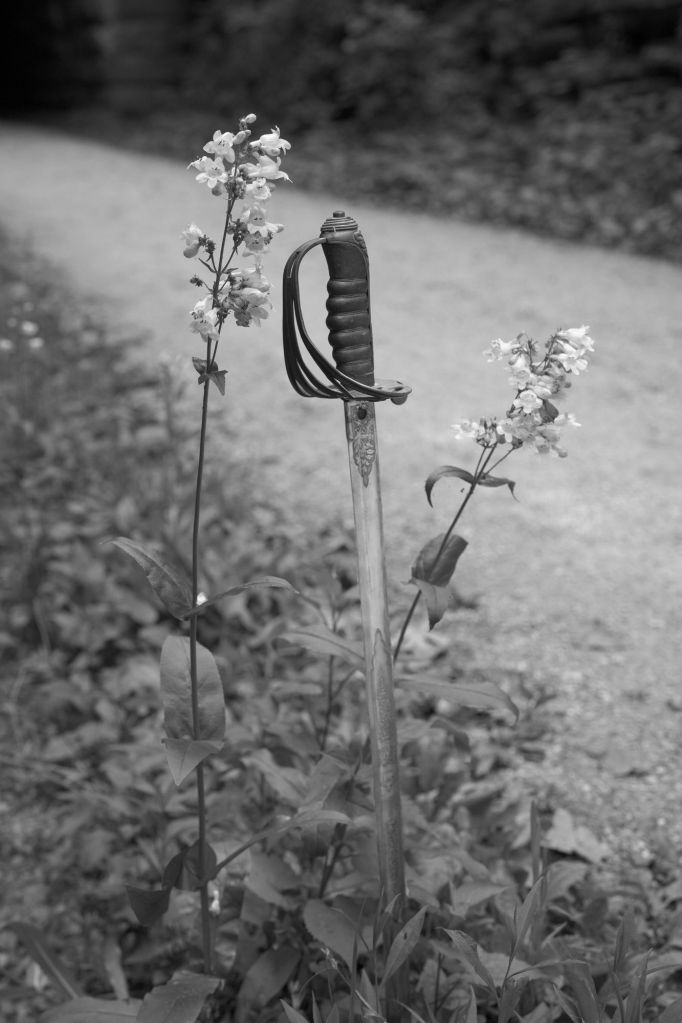
is where I draw my sword.
I had to learn sensitivity to behavioral patterns when I was so young in order to not lose my grip on what the truth was, and to predict the reactions of people that should have been a safe harbor.
Only recently have I learned that this sense can be used to recognize friends, too.
And so in spaces where I used to swing that blade at anyone who moved,
I just hold it up quietly and let them show me who they are.
And because the sword has two faces,
they see their reflection,
and I see mine.
And no matter how they choose to respond to their own clear image,
I never lose me,
even if I have to stand with only her for a while.
People like me aren’t supposed to make it in this sport.
A single alarm rang out in that hallway as I put my kit on. It had been sounding for over a month, but I had to keep moving.
This is what I do. This is who I am. This is where I want to be.
Mile 3. The sun at high noon was punching down again. I was punching through the gears on a bike that didn’t really want to stay in any of them. The ghost in my shifter was pushing back worse that day, but I just shook my head. My legs were heavy, my mind was heavier, and the expectation of what more it was going to take to reach stability was becoming a team lift.
Suddenly, I heard more alarms. The control room decided to turn right and head back home when we would normally proceed left. I exited the trail at a traffic light and sought to power down at only mile 9 at a coffee shop.
I never have everything I need, butI can’t quit. I have to move forward.
The lights in the control room turned red. I started to flip switches and seek outside support.
I have help. This isn’t as out-of-control as it seems.
Three miles to get home, and then I could just try to breathe. But as I slowed down, the output was still climbing. I dragged myself up a sustained but shallow paved climb and begged myself not to stop in the middle of it. I got home, had a quick chat with a veteran in this field (whom we call “Coach”), and pulled out all of the control rods to bring myself back to baseline.
This too shall pass.
And then I melted down. All of the variables that had been wobbling for months came to blows and the control room abandoned ship.
The alarms all screamed in an ominous choir as the hallway filled with shouting I’ve heard before.
Pathetic. You’re kidding yourself. This was always going to happen. You’re too flawed. You’re not safe.
I made my way out and watched the walls of the powerful yet supremely fragile system I had built yell back,
I warned you.
I was unable to focus on anything else for the rest of the day. All I could hear were the echos of those alarms reminding me, again- you do not have enough.
_____
I am standing here staring at the graphite all over my roof.
As much as the bike gives me power in this life, I keep trying to leave all of the external factors that don’t suit the mission at the door when I swing a leg over. The internals are meticulously maintained and observed with a critical eye, so I’m still the one in control, right?
It doesn’t really work that way. It hasn’t yet mattered how finely tuned my interoception becomes; the world I inhabit does not reflect it.
And that defies the very ethos of ‘I will the machine.‘ It takes the sacredness of my autonomy and hands it back broken, with a card that says “Get well soon,” with not even a signature.
The shrapnel I’m feeling didn’t lodge itself in my flesh just from an acutely difficult summer, though. It’s sourced from when the reactor was built, left under-resourced, unsupported, its faults neglected- a life with parents that sought compliance even when they were wrong, a societal system that gaslights the unfortunate by preaching they can just work their way out, and a social structure that absolutely cannot sit comfortably with a truth-teller.
People like me aren’t supposed to make it in this sport; we’re supposed to be realistic. Keep our heads down and sacrifice ourselves for the optics. Spit-shine shoes. Don’t cause a scene because you’ll do anything if you want something badly enough.
Because if we don’t, we have to push ourselves beyond our physical and psychological limits, alone, in ways that are detrimental even to those without complex trauma.
And perhaps the most impossible mechanic of it all is
I was racing with an organized amateur cycling team in Kentucky when the head mechanic of our shop sponsor suggested getting me a job there. They said a female presence would be great for business.
They insisted.
They were exuberant, supportive, and witty at races and practices. They were the first point-of-contact when any of us needed parts, advice, or a fix. They remembered my name was spelled with a ‘G.’ They recognized my potential, and thought I’d be a good fit.
Once I was hired, they rarely ever said my name correctly again.
They nicknamed me “Gina” (hard ‘I’), and regularly addressed me as “Snatch.”
No can do, mate.
I quickly requested that they just call me Genna, or ‘G.’ They flinched a little.
“I was just playing with you,” they said, but obliged anyway. Our rapport seemed to return to normal.
One day, I went into work with a finely-striped, red, white, and blue shirt. They said “You’re patriotic today.” They would regularly comment on my clothing choices and accessories in a way that was… specific.
They are paying a lot of attention to me.
I still have that shirt, and never wear it without remembering this minor interaction.
Inevitably, their jokes continued. I started to vocalize this pattern to everyone else in the shop. Most of them said “Yeah, they’re like that.”
Another said “Yeah… they’re like that.” This person and I soon learned that we could communicate through eye-contact alone. I noticed the head mechanic’s behavior would escalate when this person was gone. After this mirror, I asked the owner to meet in confidence, and explained my discomfort with the head mechanic’s behavior. “I’ve already told them myself that I don’t like this kind of “humor,” I said.
“I’ll talk to them,” they assured me.
The behavior continued over the days to follow, so I went to the office again.
“I don’t know what happened to you in your past, but you need to work on not being so sensitive,” the owner said.
Irrelevant.
One day, the head mechanic walked from the repair area to the retail store, where I was, with a box labelled with the ‘Spank’ brand-name. They wrote “dat ass” underneath it, and presented it in front of me… and a customer.
Ladies and gentlemen of the jury, take a moment to chuckle, gag, or whatever else that incites.
That’s funny on it’s surface, but not in its purpose.
I immediately walked back into the owner’s office with no more reservation.
“If there are not going to be consequences for their behavior, then I need to leave,” I announced.
“Okay,” they said, staring blankly at me.
That’s… it?
And so, the evening after I walked out, I made a Facebook post outlining the experience I had behind the scenes while the world went on expressing appreciation for “friendly support and good deals” out the front. The owner called me and left a voicemail telling me to take the post down,
and the head mechanic sent me a long, incoherent text threatening to kill themselves.
I call a witness to the stand.
For weeks, at least, another person in the local bike community sent me various posts through Instagram DM. They trended either thought-provoking, or funny. But, they were only posts, not actual messages, and there were no recurrent themes or patterns between them that I could determine. I ignored them.
You’re going to have to tell me why you’re here.
It continued. Sporadically, and quietly. It didn’t increase, nor taper.
One evening, I finally replied out of sheer lonliness. And without much ado, they began to explain that they had heard about my falling out with that shop. They also told me that this head mechanic had called other shops in the area in the aftermath, warning them all not to hire me. I caused drama.
And this person just… didn’t buy it.
They sent me a document they had found. A record.
A criminal record. One count of domestic assault, another of impersonating a peace officer. They were on parole.
I got word that this mechanic incurred a divorce, lost custody of their young child, and moved to Alaska in the years to follow.
The individual who believed me is now one of the most important people in my life.
Final observation: Combustible material incorrectly labelled as irritant. Please avoid the area.
For those members of the jury who were not present for prior testimony:
This individual reached out to me about this blog as a resonant reader. We developed a rapid connection, but through admission delayed until after I began to ask questions, I came to learn this person was perusing divorce but still living with their spouse. Throughout my life I had learned to anticipate “the catch” when finding a job opportunity, love interest, or means of assistance that seemed too good to be true. I noticed a subtle side-stepping of boundaries, omission where words should have provided clarity, and an enthusiasm that did not match the realism of the situation.
I told them I was no longer willing to participate, and wished them well.
The silence to follow didn’t sit the way it usually does.
As I’ve demonstrated, I will walk away. I don’t fight, I don’t defend, and I don’t refute. I let people show me who they are, and collect my evidence over time. If something doesn’t sit right, I don’t respond right away- I just start watching.
The body knows it first. I trust it, so when I felt it start to shut this person out, I didn’t interrogate it any further.
But oh, how I interrogated me.
In these circumstances, the stages of detaching are grief, but also…
satisfaction. I’ve stood up for myself even at a cost.
I didn’t get either this time. Actually, I received this soft- featherlike tap on my shoulder that suggested that the cost here might not be just temporary discomfort.
They didn’t intend to hurt me.
Stay with me. This isn’t enough.
But I asked if they would be open to a phone call. They said yes. I asked when. They said as soon as possible.
During that call, any emphasis on “intent” I made certain to steer back to “impact.” And while we were examining that together, they told me they felt “burned at the stake,” by what I wrote about them, but also,
“You’re right.”
Not submissively. Not to please me. It was a realization of effect.
They proceeded to open up to me, sincerely rather than performatively (the difference here can be heard), about everything they were trying to manage all at once while feeling trapped. Decisions cause ripples. Honesty is not a sterile procedure no matter how hard I have tried to make it one.
They said “You’re intense, so intense,” but also
I still want to be close to this.
Ladies and gentlemen of the jury, most people run from me. They fight, tell me I’m the problem, or disappear, all for using my words to narrate their behavior back to them. They rarely stay long enough to understand that on the other side of the scale is a quieter humanity that just wants to not be lied to anymore.
But here on the phone was not another person who was trying to hide themselves, but was weighing the cost of exposure in a period of major overwhelm and overlooking the impact of omission entirely.
I want to allow people to be different from those I have known.
And so, I walked back. Not with erasure of the problem, but with agency over what I was willing to accept circumstantially. I rendered verdict because I was uncomfortable with things that were absolute red flags, but then I asked me “why?”

 I will the machine.