Tag: philosophy

  • In Pursuit of Paradox

    I was driving home from work last week on an evening with one of the more saturated sunsets I’ve seen in my life- violet clouds singed with orange, crepuscular rays streaming upward as if God was about to make an otherworldly announcement.

    The clouds then took on a strange, hazy filter until I traced the smoke line to a structure fire just off of an exit ramp. The flames reached up above the trees, and the strobe of a battalion of fire engines evoked the feeling of emergency in me. I’ve seen my home burn before, had police and paramedics called to the house I lived in in high school more than once; the urgency and grief in the visual leaked back in like time travel. Yet as the scene came and went out of the passenger side of my van, I just looked back to the road ahead and said,

    “Ah, Paradox.”

    _____

    Labelling myself as a survivor doesn’t sit correctly. As I get further away from history, observer suits me more. It removes me from unwilling participant to autonomous documentarian. Where my focus was once on understanding how things happened, and why they did, I’ve begun to develop the ability to just look at what is happening with no need to understand simply because it no longer threatens me.

    And somehow, I understand it more only then.

    This year, I found a system of support that has provided me with safety for long enough that I have been able to spend less cognitive energy on acute problem-solving, and more on what my mind was built for. I’ve finally felt the ability to rest, and my body thanked me by nearly collapsing completely once we no longer had anything to run from. My most inconsistent and lackluster season has become the most affirming of purpose.

    _____

    I used to equate praise with safety, and silence with rejection. I have been surrounded by silence- like enemy forces closing in with no intent to ever strike, or ever allow me to flee. Praise was the breadcrumb, and Silence was overlord of acceptance that struck the gavel every time I spoke.

    I’ve since learned Praise is often a cheapskate, and Silence is seldom brave.

    _____

    Papa, my maternal grandfather whom I recognize as my true parent, passed away before I had the grounding to ask him the questions I really needed to. He often attributed weakness to my thoughtfulness. Accepted only tangible gain as growth. Did not understand why I enjoyed running in the nature of his farm most when I listened to music instead of birdsong, and yelled at me to take off my headphones. Did not support my athletic drive until I broke a record.

    And given the dysfunction of the family system on a broad scale, I have been left to wonder how much of his love was limited by generational difference, or a need for power and control. If my love for him was a projection of what I so dearly wanted him to see in me, because it wasn’t being accepted by either of us. Or, if it was because I saw in him its source.

    And Paradox says,

    “Yes.”

    _____

    For some reason,

    Silence has entered the room with Invitation lately.

    Someone I have long admired, someone I perceived as above me, meeting me and saying,

    “I have so many questions,” with enthusiasm.

    People who have perceived me as intense, or at least met me with no reply to my casual, loaded comments, coming back to me with paragraphs of their own deeper experience, unprompted.

    People becoming warmer to me the more I dare speak, suddenly.

    And between the extremes of I don’t see you, and I’m listening,

    sits Paradox, as mediator- not judge, but arbiter.

    And when I say, “I don’t know how to feel. I don’t know what the truth is.”

    Paradox says,

    “Yes.”

    And so it is settled.
  • Goin’ Up on a Tuesday: A Question of Ethics and Advantage for a Record Ride

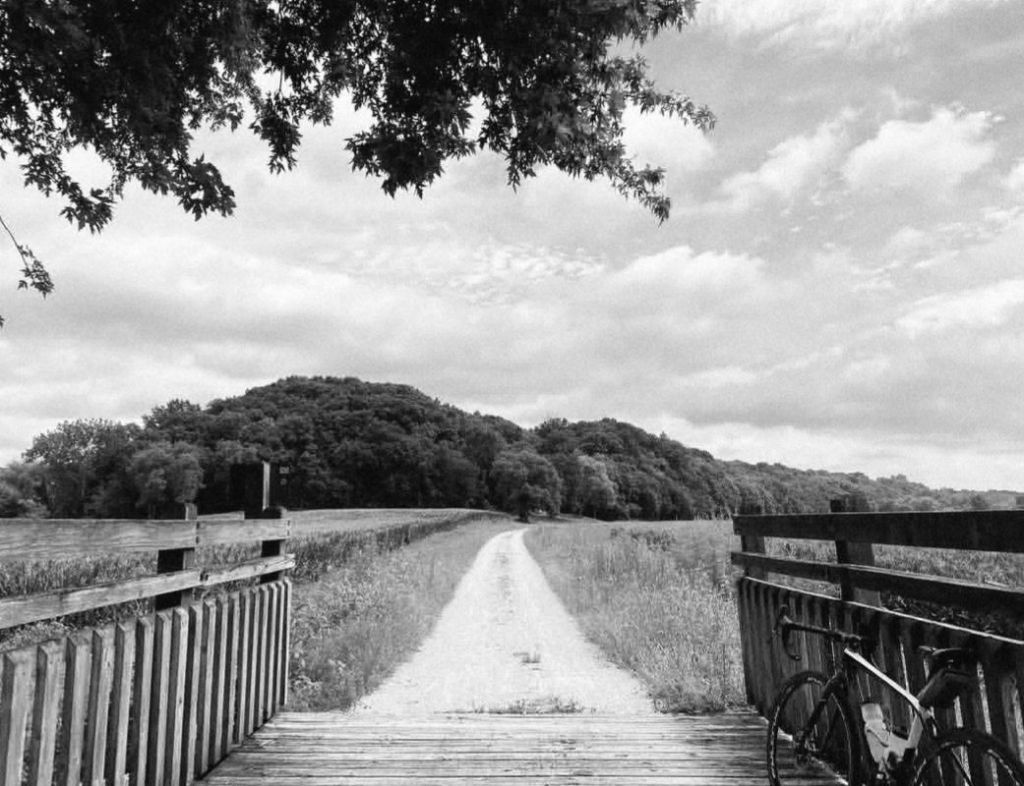
    This month, both the men’s and the women’s fastest-known-time records for the 239-mile Katy Trail were broken. The route is run from the western terminus in Clinton, MO to the east in Machens. The trail is predominantly flat with one section of subtle grades that stretches roughly 30 miles, and highly exposed for long and frequent periods.

    The latter was accomplished on October 21st, a Tuesday, with a steady wind out of the west-southwest at 18-25 miles-per-hour, with gusts higher, according to the National Weather Service.

    I planned my own ride that day with consideration of that windspeed, choosing to ride the local section of the trail southeast and attempting to hide from the turbulence in the hills on the way back home. That was hardly effective, and I nearly put a foot down on a paved climb as a gust brought me close to a stop.

    I titled that ride on Strava “Why?” as in why the f*** am I out in this? It was arguably a perfect day to be on a bike otherwise.

    Dear reader,

    It was my record time that was bested that day. Before I continue, I want to acknowledge that I am in a strange position as an athlete, writer, analyst, and deeply critical thinker compelled to question a result, fully aware of my own bias. I want to make it known that I am not contesting that the result be disqualified, or commenting on the character or personal motive of the athlete at the center.

    Records exist to be broken. The pursuit of them is what gives them their value. They are a numeric representation of having discipline, a drive toward exploring human capacity in physical and psychological arenas, and cojones of record proportions of their own.

    With that being said, I raise you this:

    1. How much did an environmental advantage possibly augment a result?

    FKT’s are determined by elapsed time, rather than moving speed. I have had to defend that fact on my first completion of this ride in 2022, and I am not going to nitpick that on someone else’s data now. This comparison is presented for my inquiry of wind effect.

    My time: 14:40 moving, 16:27 elapsed

    New record: 14:00 moving, 14:33 elapsed

    Only 40 minutes of that time difference is moving speed; the rest is stopped time. Whether or not a major tailwind over 239 miles influences stopped time is extremely nuanced and indeterminate, so I’m not going to touch that. However, I did ask AI (I do words, not math) to calculate potential moving speed advantage of a 20mph tailwind versus the 5mph wind from the southwest that I had during my effort:

    On flat terrain at endurance pace, a stronger tailwind lowers effective airspeed, so the same effort yields a bit more ground speed. A modest ground-speed bump of +0.6 to +1.2 mph over ~239 mi translates roughly to:

    • +0.6 mph → ~25–30 min saved
    • +0.8 mph → ~35–40 min saved
    • +1.0 mph → ~45–50 min saved
    • +1.2 mph → ~55–60 min saved

    I then asked it how common this wind speed and direction was for central Missouri:

    Very high sustained tailwinds (e.g., 18–20+ mph aligned with the trail) show up as rare “strongest” wind-events rather than typical conditions. For example: one source records a “strongest 16 April, 2024 – 26.4 mph SSW” for Columbia.

    2. How does opportunistic timing possibly harm opportunity in endurance records?

    239-miles is not a neighborhood Strava segment. Riders attempting to ride the Katy (or any other solo FKT path) in one push are typically planning weeks or months in advance and crossing their fingers for weather that is manageable. Capitalizing on a rare wind event from the perfect direction to post the fastest time creates a standard that limits accessibility for anyone to challenge it that isn’t extremely lucky, can’t logistically pull together an attempt on short notice, or ‘pro enough’ to beat it in normal conditions. As an outside example, a tailwind advantage is so widely recognized that the Boston Marathon winners’ finish times are ineligible for world record consideration because of the high probability of tailwind skew.

    Nothing about this choice is against the very few rules of the FKT, and all that technically counts is the data recorded and the label of ‘supported’ or ‘unsupported’. And, giving grace to the small chance a challenger lucks out with conditions that favorable, there is, in my opinion, a responsibility to be transparent about that variable.

    3. If how we approach individual athletic feats of this scale is boiled down to just the data that qualifies, does the rest of the story matter?

    I can’t answer that for you, dear reader. For me, the whole story is the definition of an effort, even if I’m not on the top step. All of my previous work is written from what ultra-endurance endeavors showed me about myself rather than what they communicated to observers.

    I don’t want to be the frontrunner from anything other than what I am capable of under my own power.

    And since the sword imagery I use in my writing is not there because I’m simply a keyboard warrior, I am going to try to run the new posted time down next season in more neutral conditions.

    And if you’re still compelled to ask me, “Why?”

    then I have a counter-question for you.

    4. Why would anyone need the wind?